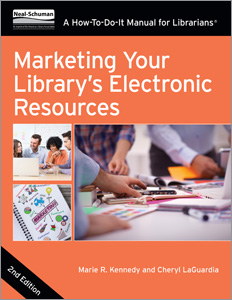
books on electronic resource management

Here’s a mini-bibliography of monographs published on the subject of electronic resource management. Happy reading! If you know of one that I’ve left off the list, please leave a comment with the info.

2009. Jones, Wayne (ed.). E-journals Access and Management. Routledge.

2008. Albitz, Becky. Licensing and Managing Electronic Resources. Oxford: Chandos Publishing.

2008. Yu, Holly, and Scott Breivold, eds. Electronic Resource Management in Libraries: Research and Practice. Information Science Reference. {nb: I wrote a chapter in this one}

2006. Hepfer, Cindy, and Pamela M. Bluh Managing Electronic Resources: Contemporary Problems And Emerging Issues (ALCTS Papers on Library Technical Services and Collections, No. 13.).

2004. Conger, Joan E. Collaborative Electronic Resource Management: From Acquisitions to Assessment Libraries Unlimited.

2000/2005. Gregory, Vicki L. Selecting and Managing Electronic Resources: A How-To-Do-It Manual (How to Do It Manuals for Librarians) Neal Schuman Pub.

2003. Cole, Jim, Wayne Jones, and David C. Fowler. E-Serials Collection Management: Transitions, Trends, and Technicalities. CRC.

2002. Harris, Lesley. Licensing Digital Content: A Practical Guide for Librarians. ALA Editions.

Posted in e-resource mgmt, library, management, usage statistics | 3 Comments

did you know you can buy journal articles on Amazon?

i was doing a quick keyword search for “electronic resource management” on amazon today, to see how many books are available on that topic. i was surprised to see mixed in with the books a link to an article i had written that was available for purchase and download.  did you know that some articles are available online this way?  have you ever purchased one?

Dreams of perfect programs: Managing the acquisition of electronic resources [An article from: Library Collections, Acquisitions and Technical Services] [HTML] (Digital) M.R. Kennedy

screen shot of article

screen shot of article

Posted in management, writing | Comments Off on did you know you can buy journal articles on Amazon?

monkey see, monkey do

cat
more cat pictures

Posted in monkeys/bananas | 1 Comment

which is the marked category: print or electronic?

stimulating post today on SERIALST, an email forum devoted to serial publications. the author posed the question if we should distinguish in catalog records which publications are in print format because patrons now expect that a serial is chiefly published electronically. until now we’ve assumed that any publication is in analog format and have only distinguished in the catalog record when it is electronic (really we distinguish the alternate format if it’s something other than print, but for this discussion let’s stay on the binary distinction print-electronic).

what we’re witnessing here is a cultural shift, where the thing that used to be assumed is no longer assumed. this is exciting because these shifts tend to happen slowly, imperceptibly, and you don’t notice it happening until, for example, all the sudden you’re calling digital photographs “photographs,” when “photographs” used to only be analog. when did the change take place? it’s hard to pinpoint, so being able to note a time in history where you can see a shift occurring is exciting. today’s forum post is such an occasion.

making this kind of distinction is called “marking”. the “unmarked category” is the expected or usual thing, whereas the “marked category” is out of the ordinary. until now, serials in print were the historical norm and were not distinguished with any special notes in a catalog record. the forum post today suggests that patrons now expect that electronic format is the expected way that serials are published, making the print version out of the ordinary.

the models for marking fall into two general categories: either/or or type-of. the either/or, or antonymous, model, suggests exclusivity, such as noting that two terms are in opposition. an illustration of this is found in the terms like and liked. term-1, like, is the norm/unmarked in english because the present tense is the assumed tense, whereas term-2, liked, is past tense, less commonly used, and therefore marked. the type-of, or hyponymous, model, suggests a hierarchy or superordinate structure. in this model, term-1 would be considered a kind of the root. in the same way, term-2 would also be a kind of the root. days of the week, as an example of this model, could be considered the root, with workweek as term-1 and weekend as term-2 (Battistella, 1990).

if we decide to start noting in the catalog which serials are published in print, when will we begin that process, and how? stay tuned to the discussion by subscribing to the SERIALST forum.

Battistella, E.L. (1990) Markedness: The evaluative superstructure of language. Albany, NY: State University of New York Press.

Posted in writing | 1 Comment

what i’m reading now

what i'm reading now

what i'm reading now

Posted in articles i'm reading | 2 Comments

Science!

germ wrangler

germ wrangler

Posted in images, monkeys/bananas | Comments Off on Science!