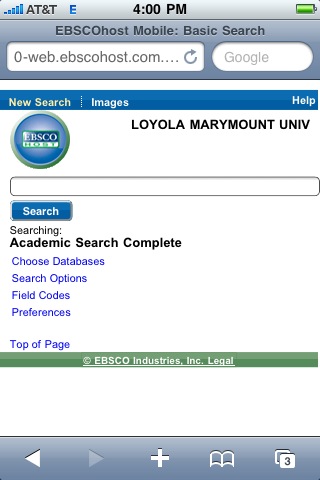
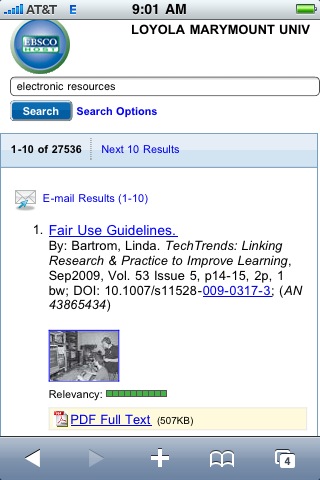
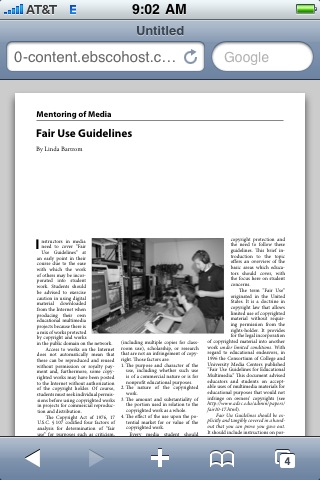
how to use this database

how to use this database

Posted in comic | Comments Off on how to use this database

white boards: evolution

in our new library the group study room walls are called “wall talkers.”  the white walls have a coating which can be written on with special markers.  it’s perfect for taking notes for a group meeting, or working through an idea together.  some people get creative with the use of the boards.

evolution

evolution

Posted in images, library, white boards | Comments Off on white boards: evolution

what I’m reading: Speaking of Books

http://southernlibrarianship.icaap.org/content/v10n01/hackman_t01.html

Timothy Hackman
Speaking of Books… Connecting with Faculty through a Campus Author Series
Electronic Journal of Academic and Special Librarianship
v.10 no.1 (Spring 2009)

Posted in articles i'm reading | Comments Off on what I’m reading: Speaking of Books

advertising a new book series

we’ve launched a new series in our library to celebrate major publications or creative works by university faculty.  other universities have had similar kinds of author series (1), but this is a first for our library.  i put out a call for presenters via email through our library liaisons to their respective departments and had one printed flyer at our information desk during new faculty orientation.  from those modest gestures my inbox was flooded with requests to present.  we decided that with all of the other new programs that the library is sponsoring this fall that we would invite four presenters.  those four have now been scheduled and we’re turning our attention to advertising the series.  i thought i would share the specific things we’ll be doing, just in case you’re developing a book series for your library and are wondering how to draw interest to it.  if you’ve already done something similar at your library, please share your expertise in the comments.  is there a promotional technique that you used that was successful?  let me know!

the series, called “faculty pub night,” is geared toward the entire university community.  that means faculty, staff, students, and the people that live in the surrounding neighborhoods.

  • put an event notice up through our campus-wide online communication tool.
  • put a notice on our library blog, library news (http://lmulibrary.typepad.com/)
  • put a notice on our pages in facebook and myspace
  • add a jpeg of the flyer to our account on flickr
  • make a libguide for the series
  • send print flyers to our two local public libraries
  • send some print flyers, as well as pdf versions, to the faculty speaking in the series
  • put notices in our local community newspapers. there are four in our area: daily breeze, the argonaut, hometown news, and the la times book events

1. University of Maryland http://www.lib.umd.edu/MCK/booktalks.html ; UMass Dartmouth http://www.umassd.edu/meettheauthor/about.cfm

Posted in library | Comments Off on advertising a new book series

starting a research project with a structured abstract

have you ever gotten a fantastic idea for a research project and were then immediately stumped about what to do next?  if so, starting your research with the magical four key points of a structured abstract may help you make sense of the mess you’ve just made for yourself.

  • OBJECTIVE
  • METHODS
  • RESULTS
  • CONCLUSIONS

these four steps are essential in conveying to someone what your question was and how you went about answering it, as well as what you found and what the results imply.  these steps work no matter how complex or simple your research question is.  isn’t that great?

whenever i start a research project the first thing i do is a little brainstorming with myself in microsoft word.  i keep this part of the research loose, typing out whatever tangents i have that may relate to the topic i’m interested, as well as all the kinds of questions i can ask about that topic.  i don’t judge anything i write at this point.  for me, it’s helpful just to let my mind wander around an idea so that eventually, after time, i naturally narrow down my idea to one manageable idea.  eventually i’ll decide that of all the questions i’ve written down, that that is the one i want to answer.  then i head for the second thing, the first two steps in a structured abstract.

  • OBJECTIVE

next to objective i’ll write out what i’m trying to find out by asking the question i’m asking, and why it’s important.  it’s amazing how simply writing this out for myself in two or three sentences will either clarify for me that, yes, this is a project i want to spend the next two to three months on or no, i don’t care enough about this question to pursue it.  this step also helps me narrow down my idea so that i can understand if my objective is achievable in one paper, or if it needs to be split into several papers; i’ve found it is most useful for an article to contain one main idea that is well considered rather than trying to squish too many ideas into one article.  writing down the objective also helps me figure out if i need help with the project i’m outlining.  this naturally leads to step 2,

  • METHODS

how, specifically, am i going to answer the question i’m asking?  do i know enough about x to comment on it confidently, or am i going to need help?  is what i’m proposing going to require  statistical analysis?  if so, who do i know that can help me with that?  what are the minimal number of specific things i’m going to need to do to answer my question?  the methods step is where that all gets figured out.

from this point on, the real fun starts.  then i get to actually go answer the question, and once i’m done i’ll follow up with the last two steps,

  • RESULTS
  • CONCLUSIONS

Posted in writing | Comments Off on starting a research project with a structured abstract

the virtuous circle

i was just introduced to the term virtuous circle. it means, according to dictionary.com, “a beneficial cycle of events or incidents, each having a positive effect on the next.”  how nice is that!

Posted in the grammar doctor checks in | Comments Off on the virtuous circle