I recently attended the Qualitative and Quantitative Methods in Libraries conference in Rome, Italy, and had a blast. What a treat to see librarians and library researchers from across the globe present the results of their mixed methods research. It was especially nice to not have to explain why one would want to use both qual and quant at the same time, but rather it was just accepted that using both is how some really well informed research gets done.
We presented the results of two new research projects (my co-investigator is David P. Kennedy of RAND). Listed here are our abstracts and links to presentation slides.
- Developing a Mixed Qualitative and Quantitative Research Design to Inform Library Policy Decision-making
When faced with the need to make decisions about library policies, such as offering new services, discontinuing existing services, or marketing underutilized services, administrators often need to better understand patron expectations of the library. For example, if new services do not meet the expectations of patrons, these services may not be used or appreciated and resources devoted to developing these new services may be wasted. Also, if existing services are seen as essential to patrons’ expectations of a functioning library, patrons may react negatively to discontinuation of these services. In addition, communicating with patrons about policy changes without fully understanding their expectations my result in marketing campaigns that are ineffective, misunderstood or ignored. Therefore, understanding shared patron conceptualizations of library functions is essential to successful policy development and implementation.
In this presentation, we provide an extended example of a mixed qualitative and quantitative research design for identifying the shared conceptualization of library functions. We discuss methods of collecting and analyzing data from the field of cognitive anthropology, including freelisting, pile sorting, and cultural consensus analysis. These methods are designed to explore a domain of information that may or may not have strong cultural agreement, to identify the culturally salient elements of this domain, to identify which elements are core elements and which are peripheral, and to provide a means of testing if there is cultural agreement for the domain in a particular population. We will apply these methods to the domain of a library’s function on a university campus in the United States and discuss the usefulness of these methods to the development and implementation of library policy.
http://www.slideshare.net/orgmonkey/qqml-d-kennedy
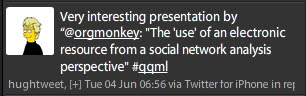
- The “Use” of an Electronic Resource from a Social Network Analysis Perspective
Academic libraries in the United States commonly employ COUNTER or proxy server statistics to describe the use of their electronic resources, but we know that a “use” is arguably more than a full-text download or web page “hit.” This presentation reports on an analysis of data gathered at the Loyola Marymount University (Los Angeles, California) from library reference encounters with patrons during which an electronic resource is mentioned. Social network analysis is used to examine the relationship between a patron, a librarian, and an electronic resource to more fully describe the use of the resource. This research provides a framing mechanism for comparison between traditional COUNTER statistics, proxy server statistics, and the social network analysis perspective.
http://www.slideshare.net/orgmonkey/the-use-of-an-electronic-resource-from-a-social-network-analysis-perspective
We’re working on writing up the results for publication, soon-ish. 🙂 Let me know if you’d like an advanced peek at either of the two articles.
Here are two twitter screen shots about our presentations: