COUNTER 5 SUSHI harvester

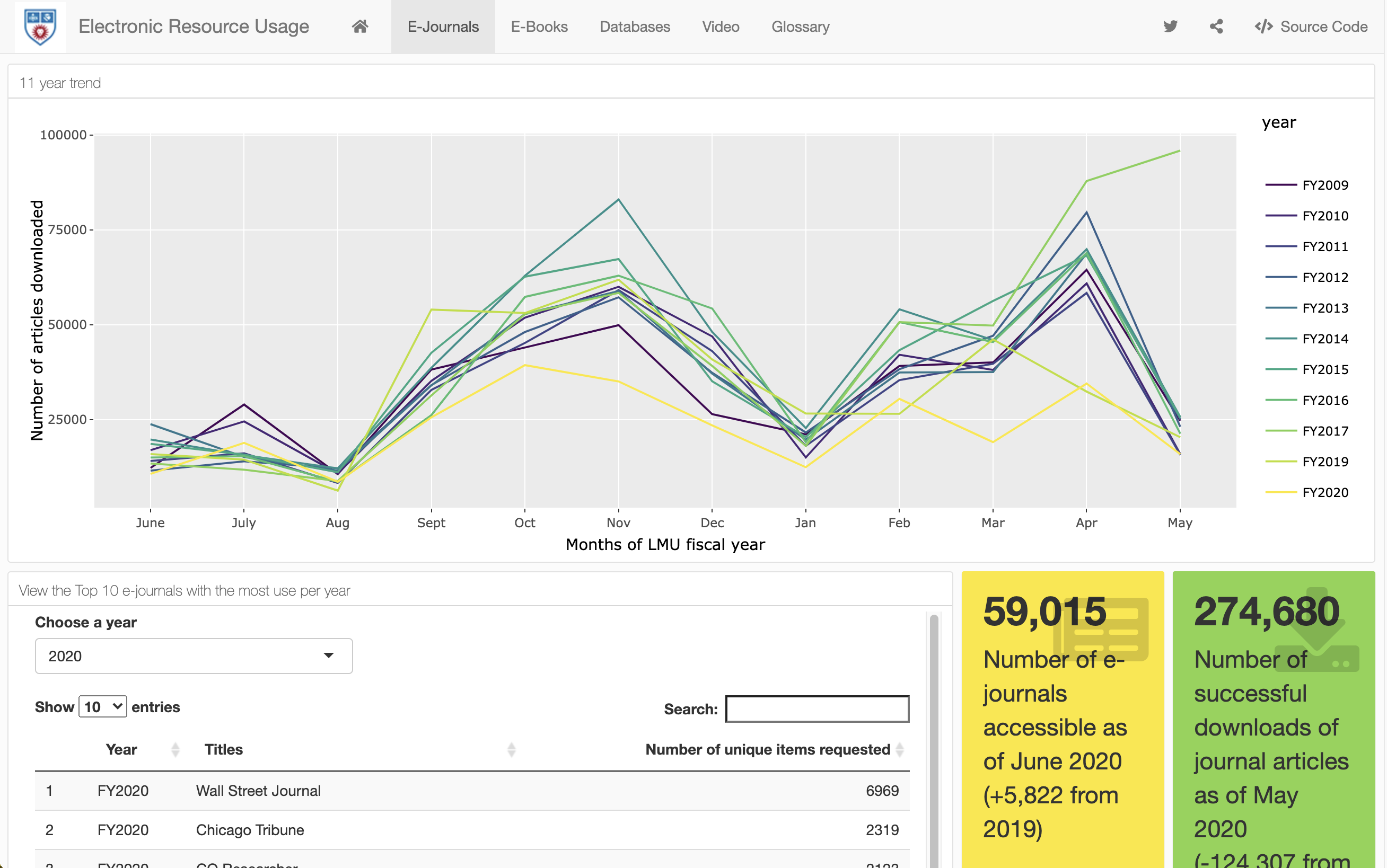
Annually I compile COUNTER usage statistics of our licensed e-resources to contribute to our library’s national reports and to update our local e-resources statistics dashboard. Until last year this was a manual process requiring a significant amount of time. I would need to log in to a separate administrative portal of over 60 platforms, to download Excel spreadsheets of usage data for over 350 resources. Because we report based on our fiscal year (June 1 start) I would need to download two calendar-year spreadsheets and then combine them into one. Compiling all of the disparate data into three categories of e-journals, e-books, and databases, and then condensing it into bite-sized pieces (e.g., bar charts of use per month, top 10 e-journals) for our stakeholders took the longest amount of time. I frequently had help downloading the reports and was often rushed in condensing the data, arguably the most important part of even having the data.

Last year we subscribed to a service (RedLink) that would fetch those reports for us, using the SUSHI protocol. Setting up the service took a while, to discover the correct server URLs for each platform, requesting the creation of an API key that would give the service permission to download reports on our behalf, and then to convey that data to the service provider. I was elated that my annual compilation took far less time, and I could better enjoy the process.

This spring I was alerted that the service was going out of business. I considered several other commercial SUSHI harvesting services, but they were significantly more expensive than our subscription to RedLink had been. It seemed to me to be poor stewardship of our library’s funds to request a more expensive service in the midst of a global pandemic and uncertain budgetary future. I started looking for freely available services and was discouraged at EBSCO’s R5 Harvester tool (requires Microsoft Access and a Windows computer, neither of which I currently have). I was soon delighted, however, to come across Melissa Belvadi’s COUNTER 5 SUSHI harvester.

I installed it on my Mac with ease, downloaded the vendor lists file (a starter file, with many of the vendors we use) and manually entered the SUSHI credentials into the tool. Within an afternoon I was able to start fetching reports and adjusting the credentials for some finicky vendors. I really like that I can export into a single file all of the vendor credentials, so that I can share that file with another member of our team, and they can import it and fetch reports.

All of the data presented on our e-resources stats dashboard for the latest fiscal year was generated from this tool. I am so grateful to have a freely available tool that is also easy to use. Thank you to the team that built it!

Screen shot of the COUNTER 5 SUSHI harvester tool

Screen shot of the COUNTER 5 SUSHI harvester tool

Posted in e-resource mgmt, usage statistics | Comments Off on COUNTER 5 SUSHI harvester

California Cheese Trail

You know that question people sometimes like to ask, “If you were going to die tomorrow, what would your last meal be?” Pretty ominous question, come to think of it. But my answer is always, “A warm baguette, grapes, wine, and a variety of cheeses.” Dave often delights me by bringing home from the grocery store cheeses we haven’t tried before, gathered from the basket in the cheese area of end pieces and sample sizes.

We really ended up living in a great area of the United States. California has its own tourism sector, related to cheese: California Cheese Trail. I want to eventually go visit them in person and maybe pet some goats and cows. Since we’ve had to stay at home during the pandemic lockdown we’ve decided to start a virtual tour, ordering from three of the cheesemakers on the list so far. Our first order was from Cowgirl Creamery, a women-owned company. Next we tried Nicasio Cheese, a family-owned business. And just today our order from Petaluma Creamery arrived.

If you’re a fan of other California cheeses, fill me in, I’d love to try them.

October 19 update: just placed an order from Vella Cheese Company!

February 2021 update: ordered from Point Reyes Farmstead!

March 2021 update: ordered from Stepladder Creamery!

A picture of a map of California cheesemakers

Posted in monkeys/bananas | Comments Off on California Cheese Trail

A new “Scholarship that cites my work” section of my annual review

I usually start drafting my annual performance review report in the spring, in anticipation of finishing it before the start of the next fiscal year (June 1 start). Now that I have attained Librarian status, which is the highest promotion level at my institution, I can begin to reflect not just on what was accomplished during the year, but what impact my scholarship has had on the profession. An easy way to think about that is to look at the numbers of citations to publications over the years. My Google Scholar profile shows the articles and books I’ve written/co-authored and the number of times they’ve been cited over time. I wondered though, about how many times they’ve been cited simply over this last year.

I asked #AcademicTwitter if they report this in their own performance review reports. The main response I got from my question was that it was a good idea, so I thought I’d give it a try. This year I added a new section to the professional development part of my report, titled, “Scholarship that cites my work.” It took a bit of time to click through the Google Scholar profile to the citing articles, and count them if they had been published in our last fiscal year (June 2019-May 2020). What I found, though, was that a lot of my work was being used in the profession, not just one or two articles. I’ll see what kind of response I get from those reviewing my report, to decide if I want to continue to include those data in future reports.

Here’s a screen shot of the section from my report:

A new Works Cited section of my annual review

Posted in twitter, writing | Comments Off on A new “Scholarship that cites my work” section of my annual review

Remembering Walter Walker

I am reminded of a brief interaction I had with Walt Walker at a library event last fall, during which I told him about the work I was doing to acquire monographs by or about women scientists, to add to the LMU collection. I wanted to do this, especially in my role as liaison to the departments of Chemistry and Physics, so that our students saw themselves reflected in our collection. He responded casually, saying something like, “Oh, I’ve been adding additional subject headings to those bibliographic records of that kind of material for years, so that the books are found when a patron searches the catalog.” From that, I knew I had an ally, but better yet, our library collection and its patrons had an ally.

Walt’s work had both a regional and international reach, locally as a founding member of ACT UP/L.A. and as a volunteer with ONE National Gay and Lesbian Archives, and his efforts as an editorial board member of Homosaurus, an international-linked data vocabulary of LGBTQ terms. To me, he was also just Walt, a colleague with a great laugh who worked two offices away from mine. I am sad to hear of his passing on 6/11/20.

Posted in library | Comments Off on Remembering Walter Walker

Usage statistics season

Our university’s fiscal year just ended on May 31 so it is time to complete all of our end-of-season tasks. A big task that I’m responsible for is gathering usage statistics for our electronic resources, to contribute to some annual library reports. Every year I check to see if e-resources that didn’t offer COUNTER usage statistics before, do now. I came across the Chronicle of Higher Education and wondered if they offered COUNTER.

Hah, NOPE.

A screen shot of the Chronicle of Higher Education usage statistics page (it's laid out truly terribly)

~~ The Horror ~~

Posted in e-resource mgmt, titter, usage statistics | Comments Off on Usage statistics season

#WomenInScience

At LMU, I am the library liaison to the departments of Physics and Chemistry & Biochemistry. Last year I worked through a review of Physics and Chemistry monograph titles for possible withdrawal from the library collection, as part of our Sustainable Collection Growth project. For that review, I used a spreadsheet provided by the Collection Development and Evaluation Librarian to determine which titles could be removed from the collection, due to the age of the material, number of uses from our patrons, or how many other libraries had the same material in their collection.

As I reviewed the spreadsheet for the Sustainable Collection Growth project, I noticed that the majority of the authors of the Physics and Chemistry books on the spreadsheet were men. I combed through the library catalog using subject searches for all of the sciences, one by one, to see if I could identify significant works either authored by women or were about women scientists. I also conducted internet searches for advice to readers of scientific content written by or about women. From those internet searches I was able to identify some “must have” monographs, and used my collection funds to buy those items. I am pleased to note that our library collection already contained a majority of those “must have” items.

To draw attention to the print and electronic content in our collection that focuses on women scientists I developed a twitter series for the library’s account. I solicited contributions to the list from library staff and incorporated their suggestions into the series, with one tweet per week planned for a whole year (50 tweets). Each tweet includes a brief summary of the content about what makes it special. Here are a few examples:

Posted in library, twitter | Comments Off on #WomenInScience