
What started it all: http://friendfeed.com/lsw/4ad34a8d/inspired-by-this-thread
Where the cod has been recently: Eagle Dawg Blog
What started it all: http://friendfeed.com/lsw/4ad34a8d/inspired-by-this-thread
Where the cod has been recently: Eagle Dawg Blog
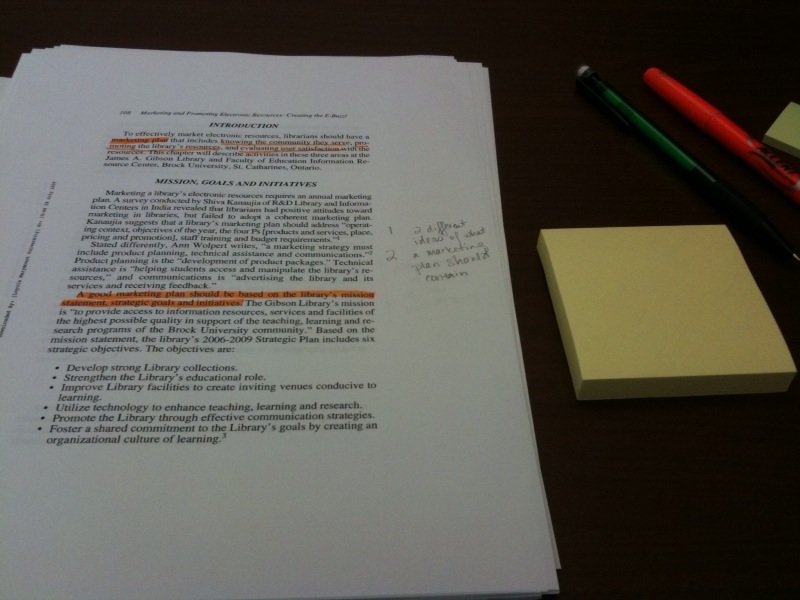
if you’re an academic librarian you probably have a stack of articles you’re waiting to read. what’s your process? i usually read at my desk in the office. there are few visual distractions there, which works for me concentration-wise (cute puppies to pet while at home, and other visual distractions). i make notes using a highlighter and a pencil. i highlight through the text for big ideas and underline text for related or smaller ideas. i use a pencil to make notes in the margin. occasionally i’ll use a post-it note to hang off the edge of a page if i have a really exciting idea that i want to make sure i remember. generally i’ll summarize the whole article on a post-it note on the front page of the article.
for being an electronic resources librarian i still find myself wholly tied to an analog process when doing my own research. are there ways that i could be moving toward a more tree-sensitive process? give me some suggestions. how do you read articles?
We are officially moved into the new library, readying ourselves to open for business on July 27, 2009. As we move to the new library we move to a new named building: the library is called the William H. Hannon Library. Here is an impressive tidbit about William H. Hannon, as gathered from the Foundation Web site:
With no money for a college education, William and his mother asked the President of Loyola University if they would admit him with the intention that William would pay back the school for his education once he got a job. William’s college education began on a handshake deal that would result in his lifelong dedication and support of his alma mater.
Read more about him in an exhibition description from the LMU Library Web site.
So much of how academic journals come to be published is mysterious to the end user, from what makes a journal cost what it costs to why or why not the journal is available electronically. You know what is starting to impress me more and more? I appreciate when a publishing entity makes a clear statement on why they do things the way they do. Case in point, Economics Bulletin. They have a whole page on their Web site devoted to why an electronic publishing format benefits their members, according to three specific criteria. The criteria they identify are dissemination, archiving, and certification. See here for the page.
Don’t miss this thoughtful comment on this page about young publications that are born digital having a possible disadvantage to those journals that have existed in the stable, old world of print and migrate to digital form: “The power of incumbency makes it extremely hard for any new journal, especially an electronic one, to develop the status that would allow its endorsement to carry the reputational weight required to certify that an article is important. This is just the way of the intellectual marketplace.”
It makes sense to me as an academic that I would want to encourage the organizations I belong to to think about these things and come up with clear statements about them. Is this important to you too, or is this a concern only for librarians that also do research?
Are there other publishing entities out there that you know of that have statements on their Web sites like Economics Bulletin? Leave the URL of the site(s) in a comment.