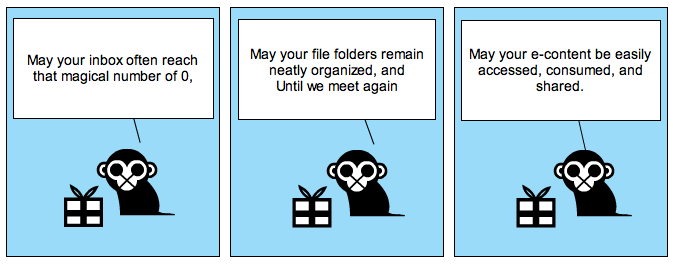
see more of my monkey comics over at http://orgmonkey.stripgenerator.com/gallery/
see more of my monkey comics over at http://orgmonkey.stripgenerator.com/gallery/
i recently asked academic librarians via a survey in which two journals they regularly read research-based articles. around 200 respondents noted that they read “college & research libraries,” but gave me lots of variation in that title. here’s what was reported:
Collage & Research Libraries
College & Research
C&RL
College & Research Libraries Journal
college and reasearch libraries
college and research libraries
College and Research Libraries
CR&L
CRL
College & research Libraries
College of Research Libraries

thanks, @eagledawg!
Applicant: K. Kringle
IRB Chair: E. Scrooge
item #7 brings the LOLs
http://depts.washington.edu/ccph/pdf_files/IRB_Letter-Christmas%5B1%5D%5B1%5D.pdf
seen on twitter: https://twitter.com/orgnet/status/15954411469676544
we here at orgmonkey.net celebrate monkey day (december 14) religiously (see 2009, 2008, 2007), usually by organizing something or suggesting that others do so. this year, why don’t you consider celebrating by contributing your response to a survey i’ve constructed?
if you’re a librarian working in an academic setting, then this survey is for you!
– – – –
We invite you to participate in a study of research skills and support for research. You have been invited to this study because you are a librarian in an academic setting.
The purpose of this study is to learn how you would assess your own skills in completing discrete research tasks as well as to discover how your institution may support your research endeavors. We plan to use the results of this survey to influence the curriculum of a proposed continuing education opportunity for librarians in an academic setting.
The survey is Web-based and is expected to take about 5 minutes to complete. We will not gather any identifying information about you.
Your participation in the study is completely voluntary and no risks are anticipated for you as a result of participating. The study has been reviewed by the Office of Research and Sponsored Projects at Loyola Marymount University.
Thank you for participating in this study.
Sincerely, Kristine Brancolini and Marie Kennedy
BEGIN THE STUDY BY GOING TO THIS LINK: http://library.lmu.edu/departments/acquisitions_serials/Informed_Consent.htm
– – –
Make this monkey’s day and take the survey!

i just finished reading theresa westbrock and sara fabian’s article in the latest college & research libraries and am sad. in their article titled “proficiencies for instruction librarians: is there still a disconnect between professional education and professional responsibilities?” they outline acrl’s proficiencies for instruction librarians from 1985 and then compare them with the 2007 updated proficiencies. the thrust of the updated proficiencies is to focus on “broad areas of proficiency rather than a comprehensive list of skills” (p. 572). are you wondering which “skills” got left behind? you guessed it: research skills.
the 1985 proficiencies (http://library.csus.edu/services/inst/indiv/acrl_bis_profic.htm) include a section titled “ability to employ research and evaluation methodologies.” here is the list of skills that fall under that heading:
looks pretty solid, doesn’t it? if i were in an undergrad sociology class i’d feel confident about having that instruction librarian teach me how do gather and analyze data.
in the new proficiencies (http://www.ala.org/ala/mgrps/divs/acrl/standards/profstandards.pdf) the word “statistics” is mentioned once: “1.3. Maintains and regularly reports accurate statistics and other records reflecting own instruction activities.”
is it possible i’m misreading the new proficiencies and that having a clear understanding of how the basic research process works is embedded in the language somewhere that i’m missing? crossing my fingers.
Westbrock, Theresa, and Sarah Fabian. 2010. “Proficiencies for Instruction Librarians: Is There Still a Disconnect Between Professional Education and Professional Responsibilities?” College & Research Libraries 71(6): 569-590.