fun thing: SCELC Research Day

Every year our regional licensing consortium, SCELC, hosts  a colloquium and a vendor day. This year the Dean of the Library and I coordinated with them to add a new themed event: Research Day. Tomorrow is the inaugural event and much of it will be live-streamed: http://www.ustream.tv/channel/scelc. Here’s a link to the schedule of events, which includes education sessions as well as plenty of peer-talk time: http://scelc.org/research-day/schedule.

We’ve designed the day to be an educational and networking event, with a focus exclusively on research. Here’s what we know about training in research methods in librarianship: In 2001 O’Connor and Park noted, “Only half of the 24 top-rated programs required MLS students to take research methods.” (a) In February 2010 61% of the 49 American Library Association (ALA)-accredited LIS degree programs with online information about degree requirements listed research methods as a required course in the curriculum. (b) By the time librarians are working professionals they have either never had a course in research design or the time lag has caused that coursework to be ineffective. This Research Day is a small step at beginning to turn that around. The goal of Research Day is to help librarians move forward with their research ideas and projects. The morning sessions are designed to improve one’s research skills, with presentations on quantitative methods, qualitative methods, choosing an appropriate methodology, analyzing data and results, and writing a research grant proposal. The afternoon provides an opportunity for librarians to report on their own research, through oral presentations or poster sessions, and to identify potential research partners or a network of support.

We have bigger plans for this that are under wraps for now but are excited to begin actively engaging on this topic with the 122 librarians who have signed up to attend the free day-long event. Check in with us via streaming (9:00am–12:15pm, then 2:30pm–4:30pm PST) or watch this space for updates about how the event turned out.


(a) Daniel O. O’Connor and Soyeon Park, “Crisis in LIS Research Capacity,” Library & Information Science Research 23 (2001): 105.

(b) Lili Luo, “Fusing Research into Practice: The Role of Research Methods Education,” Library & Information Science Research 33 (2011): 191-201.

SCELC logo


Posted in library | Comments Off on fun thing: SCELC Research Day

hosting fees

oh man, we spend so much money on hosting fees! i need to start thinking about how we’re going to nip this problem in the bud. we are charged a hosting fee when we purchase an electronic resource; the provider usually charges us an annual fee for upkeep of that resource on their platform. in this way a purchase isn’t just a purchase, it’s an initial outlay of cash with additional payments every year, in perpetuity. i don’t see how we are going to be able to sustain this model.

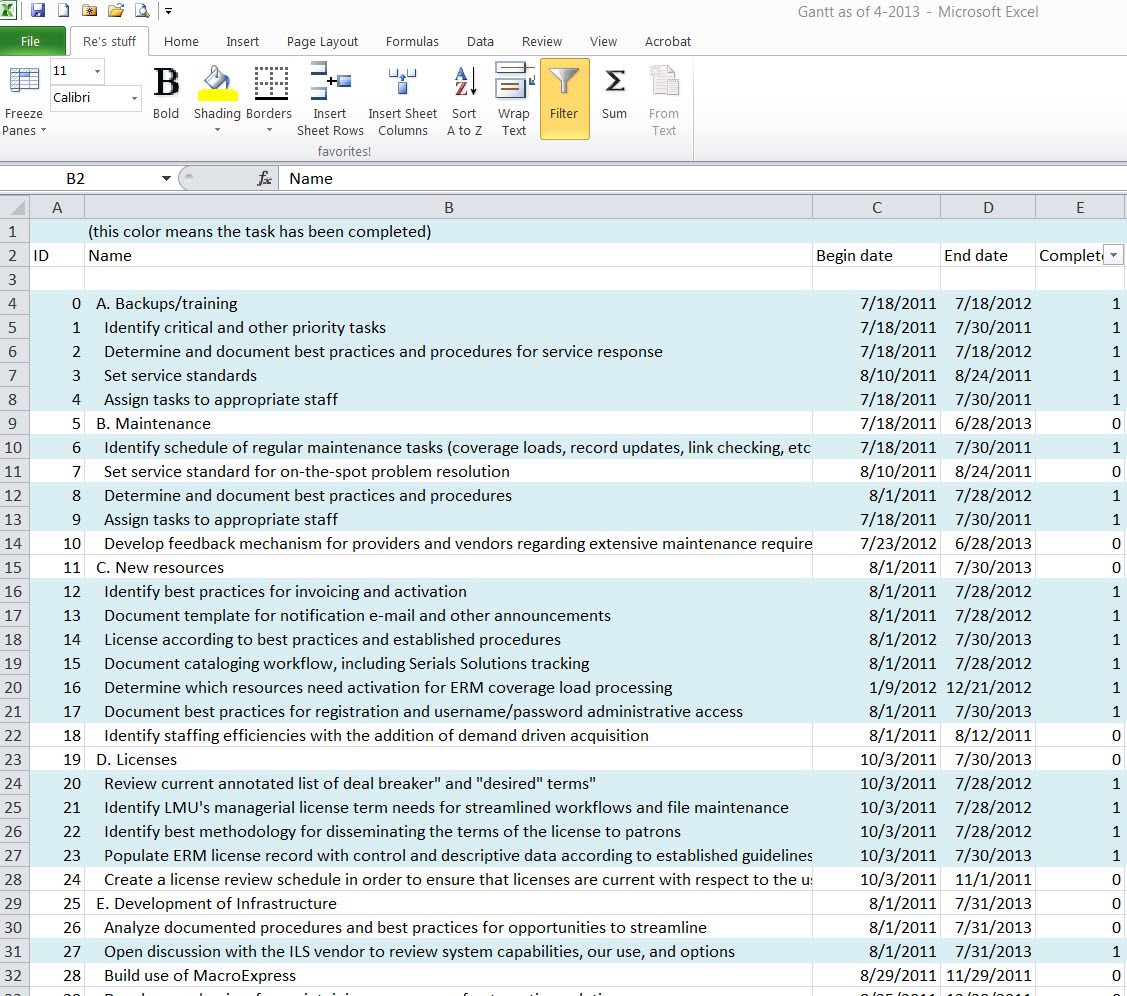
i bumped into this screen shot on our shared network drive, of how we used to have to ask our system to give us a report of all the order records that had some kind of hosting fee. we weren’t consistent in our note-making of how we identified these fees. sometimes we called them ‘hosting fees,’ sometimes we called them ‘access fees,’ etc. we resolved this problem by creating a new fund code, ‘hose,’ and all of our hosting fees for e-content are now paid on order records using that code. no more notes, and a one-line report request: show me all the active order records with ‘hose’ as the fund. this new fund makes report-pulling very easy.

search query for hosting fees

(good grief)


Posted in e-resource mgmt | Comments Off on hosting fees

#LibrarianValentine

Librarians are mushy-hearted and nerdy, as witnessed on twitter today, with the tweets using the hashtag #LibrarianValentine. There’s a log of some of the good tweets at http://storify.com/JennySarahJones/librarianvalentine.

My favorite so far:

@theREALwikiman: Roses are red, violets are blue; I have some eResources which may be beneficial to you. #LibrarianValentine

heart

http://www.flickr.com/photos/beckmann/5389625593/

Posted in e-resource mgmt, social networking, twitter | Comments Off on #LibrarianValentine

update: a place to put your (perpetual access) stuff

In 2010 we were wrestling with how to manage the inventory of our perpetual access holdings to e-journals, specifically, where to put that stuff into our ILS (http://orgmonkey.net/?p=1115). We decided on a process and are working on putting it into place. Today we completed the inventory documentation of our smallest e-journal collection. A mini-hurrah! None of this data is visible to the public; it’s in the system for our use to be able to quickly run reports or, if we were ever audited, demonstrate what we purchased using the university’s capital funds. Here’s our technical procedure:

Introduction

Some of our e-journal publisher packages provide post-cancellation access to content published while we were subscribed. In order to keep track of holdings to e-journals for which we have rights to access in perpetuity we will make notations in item records attached to the bibliographic record for those e-journals. For quick reference to that information we will also make brief notation in a 941 field on the bibliographic record.

This procedure addresses our verification process and file structure on the shared network drive as well as the data entry of verified holdings in Sierra.

Verification

On the shared network drive at G:\Acquisitions Serials\E-Resources\Perpetual Access there is a folder for each publisher package to which we have perpetual access holdings. Inside each publisher folder there is a master title/holding spreadsheet and two additional folders, one for annual title lists and one for any backfile titles/holdings lists. Inside the annual title list folder is a spreadsheet of titles/holdings for each year of access to which we are granted perpetual access.

Each year the Serials & Electronic Resources librarian will pursue an accurate list of titles and holdings from the publishers. This file will be saved in the annual title list folder, titled with the year to which the list corresponds. Access to those titles/holdings will be verified by a department student worker (click on each title and verify that a PDF can be accessed from the earliest and latest volumes). This list is then organized to fit the structure of the master title/holding spreadsheet and the data is incorporated. At that point the Electronic Resources Library Assistant is notified to begin the inventory data entry process in Sierra.

Data entry

A. In the item record:

  1. Attach New Item using the template ‘eitem’.
    Single Item
    ICODE2= n (suppress)
    Item Type= 1 (periodical)
    Location= ol (Online)
    Item Status= – (Available)
  2. Using Level 4 Textual Holdings MFHD, insert variable length field v (volume) and enter the volume, date, and perpetual access provider.
    Examples:
    v   v.20-v.29 (2000-2009) BioOne
    v   v.43-v.94 (1944-1995),v.107 (2008)- BioOne
    v   v.43-v.94 (1944-1995),(2008)- BioOne
    v   (2008-2009),v.99 (2011)- BioOne
    v   (2009)- BioOne
    v   (2009:Jun.15-2010:Aug.13),(2010:Sept.12)- SAGE
    v   (2009:Spring)- SAGE
    v   v.18:no.1 (2009:Feb.12)- Brill
    v   v.20:no.1-v.20:no.4 (2008:Mar.-2008:Dec.) Brill
    If only volume information is given, but no years, enter just the volume information. Similarly, if only years are given, enter just the year information.
  3. Insert variable length field l (license record) and enter the license record number.
    Example:
    l   l02345678

If the title moves from one publisher to another and we still retain perpetual access, track the migration via a separate item record.
Example:
v   v.20-v.29 (2000-2009) BioOne
v   v.30 (2010)- SpringerLINK

B. In the bibliographic record compile all perpetual access holdings into as many 941 fields as necessary, inserting one subfield v and l for volume and license record information for each discrete holding.
Example:
941 _ _ |vv.20-v.29 (2000-2009) BioOne|ll08765432
941 _ _ |vv.30 (2010)- SpringerLINK|ll02345678

http://en.wikipedia.org/wiki/File:M%C3%B6bius_strip.jpg


Posted in e-resource mgmt, library, license agreements | Comments Off on update: a place to put your (perpetual access) stuff

usage statistics, now with more monkey

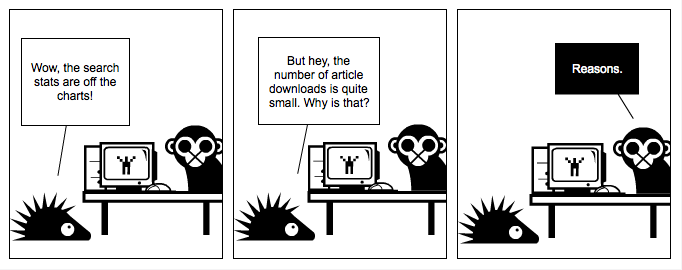
You guys know how I’m always going on about reliable methods for counting the use of library e-content? Project COUNTER is pretty much where it’s at, the standard libraries use to measure use. I’ve been following their work (http://www.projectcounter.org/index.html) since its inception and am happy to be the newest member of the group’s Executive Committee. I am the one United States-based librarian on the committee and I want to represent us well. If you’re a fellow librarian and have questions/notes/ideas to push forward, please be in touch. My three-year term for this non-profit group will be to help coordinate development of new Releases of the Code of Practice; compliance issues; marketing and communication; supervision of revenues and costs; liaisons with other relevant standards and other organizations.

counter-header

Posted in e-resource mgmt, usage statistics | Comments Off on usage statistics, now with more monkey

#ooh

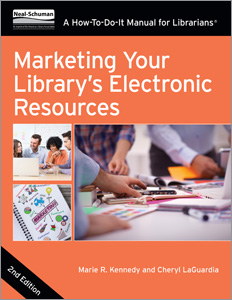
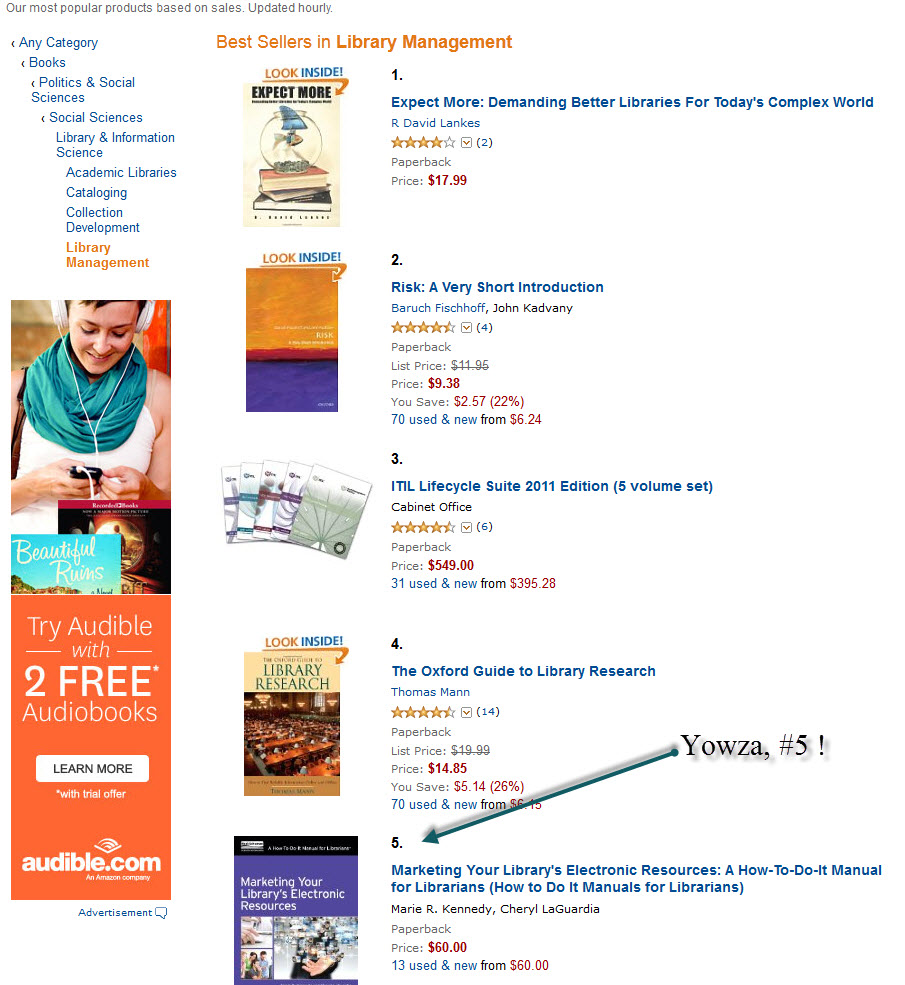
now available for pre-sale in the ala store at http://www.alastore.ala.org/detail.aspx?ID=4224.
for_sale

Posted in book, e-resource mgmt, marketing, writing | Comments Off on #ooh