Setting the scene for the IRDL summer workshop: Fidgets

The first in a series of reflections on some of the affective components of the IRDL program, things I put in place to make the Scholars feel welcomed and comfortable in the learning environment.

Fidgets (in person)

When the summer workshop was hosted in the LMU library (Los Angeles, CA) as an in-person event (2014-2019), I put a bunch of “fidgets” on each of the round tables in the training room, so that people sitting at each table could choose their own toys throughout the days to occupy their fingers during the learning sessions. I placed objects like chenille pipe cleaners in a variety of colors, squishy balls, toy cars, LEGO building blocks, crayons, coloring book pages, and small plastic animals on the tables.

At the end of each day of the workshop, I cleared the tables and reset them for the next day. As I picked up the used fidgets, I noticed that the people at the tables had cooperated in building scenes for the items found at the tables, like building a pipe-cleaner house for a plastic animal or a drawn road on several pieces of paper for the toy cars to drive on. We replaced used toys with fresh ones each day over the course of the nine-day workshop.

As we wrapped up the last day of the workshop and prepared to leave the training room for the last time, a Scholar asked if they could take their favorite fidget home with them. Clearing the tables on that last day was a breeze because they took everything. We heard from the Scholars after the workshop that the toys occupied a prized place in their work offices, as a fun memory of the workshop.

Fidgets in action. Dinosaur holding pipe cleaner, orange dog in background A table full of fidgets waiting to be packed and sent to the Scholars: glow bracelets, Nerf football, large plastic dinosaur, grow animals that you put in water, mustaches

The fidgets and hands-on materials for exercises for the in-person workshop were purchased from the Dollar Store and Amazon, for a cost of around $300.

Fidgets (online)

As we moved to hosting the summer workshop online via Zoom instead of in person (2022-2024), I thought through some options for fidgets, that might create a similar fun atmosphere in the new setting. I remembered back to when I was young and travelled during the summer in the car with my mom from Texas to visit relatives in Ohio, she would pack for me a little prize to open every day of the car trip. Those packages were delightful to me, and I couldn’t wait to see the prize each day (a paddle game, a can of Play-Doh, a jump rope). Keeping that delight in mind, I decided to pack a fidget for each Scholar, for each day of the workshop.

I put each fidget in a brown paper bag and folded it closed, with a sticker on the outside for the day on which the Scholar was to open the bag. I put ten bags into a box and sent it to each Scholar via UPS, with instructions not to open any bag until the first day of the workshop.

Here’s what I packed in each bag:

Open on Day 1: Four printed pages of advice from previous Scholars/Mentors, a Slinky, some pipe cleaners
Open on Day 2: building blocks, toy cars
Open on Day 3: 25 google eyes, giant foam dice (these fidgets could be used during the hands-on practice with sampling design)
Open on Day 4: 2 pre-stamped IRDL postcards (one to send to a friend, one to send to a colleague they thought should apply to IRDL), LMU library sticky notes, an LMU library magnet
Open on Day 5: paper drink umbrellas, plastic sunglasses (for the “beach” theme day)
Open on Day 6: single item large toy (Nerf football, dinosaur, Spirograph)
Open on Day 7: sheets of stickers
Open on Day 8: 3 small plastic animals
Open on Day 9: 3 glow bracelets, Rubik’s cube
Open on Day 10: IRDL completion badge

Large foam dice and a set of googly eyes to use in the sampling exercise

A table filled with daily treat bags, waiting to be packed into boxes

Office full of treat bags, ready to be packed and sent

The fidgets and hands-on materials for exercises for the online workshop were purchased from the Dollar Store and Amazon, for a cost of around $200. Boxes and tape to send the materials cost around $60. The library covered the cost of the mailing of the materials via UPS.

Posted in IRDL | Comments Off on Setting the scene for the IRDL summer workshop: Fidgets

An ending and a termination

This post is about the decision to end the Institute for Research Design in Librarianship (IRDL) program and the impact of the Trump administration’s dismantling of the Institute of Museum and Library Services (IMLS), the funding agency that had supported the program with three Laura Bush 21st Century Librarian grants over the last ten years.

I decided to end the administration of IRDL when the third IMLS grant was complete in late August 2025. Having met the main program goal of developing a successful model of research continuing education for librarians and archivists in a higher education setting, it seemed that the natural next steps would be to write about and share publicly what we learned while developing the model so that it might be replicated or improved upon.

I emailed the IRDL Scholars and Mentors in February to let them know we would be winding down the program at the end of the summer. I was planning a wider announcement to our grant partners and the public after the last of the 2025 IRDL Scholars’ Speaker Series sessions was complete.

I was keeping an eye on what was happening with the IMLS and was dismayed to see their staff put on leave, including the person with whom I had been in contact for several years about the IRDL grant. On April 9 I received a notice from the IMLS that the grant was terminated, as of April 8. The termination notice said that “your grant is unfortunately no longer consistent with the agency’s priorities and no longer serves the interest of the United States and the IMLS Program.”

Seven days later I received another notice, requiring me to send a narrative and financial report. As I wrote the narrative component and constructed the list of accomplishments from the latest three years of the program and the numbers of people we were able to invite into our growing community, I reflected on how even a small program like ours could reach such a wide group of practitioners.

The grant was in a no-cost extension fourth year, so that I could expend the entirety of the funds. The termination did not have a dramatic effect on the budget; there are some outstanding expenses that I will pay from a personal research fund. The main negative effect from the termination has been a personal demoralization. It stings to have thoughtfully crafted a program only to have it so carelessly dismissed. I know the work was a success, that the people welcomed into the IRDL community have been positively impacted, and the people who helped along the way built a stronger profession because of the effort.

Some of the people who helped are the staff of our partner on the grant, SCELC, which gave room to allow us to experiment with designing and administering years of Research Days programming; Sage Publishing, which sponsored the program by supplying four textbooks per Scholar, each year, for nine years; the librarians and archivists who were members of the Advisory Boards and acted as Mentors; and staff in LMU’s Office for Research and Sponsored Projects for support in administering the program and keeping track of the budget for ten years.

I post here a modified version of the narrative report I submitted so that you, too, may appreciate its impact.

RE-250170-OLS-21 Termination Follow-up

Summary of progress

In Years 1 through 4 we completed all expected activities. The main areas of focus for this grant were: the main continuing education component of designing, administering, and assessing the research training workshop and follow-up year of support and mentoring, while the Scholars completed research projects of their own design, at their home institutions; facilitating and hosting the IRDL Scholars’ Speaker Series; designing continuing education forums for extended learning, in the form of conferences and workshops.

Continuing education training program

We administered three ten-day research training workshops (in 2022, 2023, and 2024) for 85 Scholars and have then supported the trainees during their year-long process of completing their research projects. We worked with our contracted partner, San Jose State University Research Foundation, an instructor, and curriculum consultants, to redesign the curriculum for delivery in an online environment. We hired a workshop evaluator to attend each day of the workshop to observe and report on the impact of the redesign, suggesting improvements and notes from their observations.

We continued our successful mentoring program, facilitating the connection between each Scholar and a professional librarian/archivist, for a year-long research-focused relationship, with guided prompts for feedback each month. Sixty-four mentors were part of the program over the years covered by this grant, with some electing to participate as mentors in more than one year.

We track the progress of the Scholars’ completed research projects and post them at https://library.lmu.edu/irdl/irdlcohorts/workscompleted/.

IRDL Scholars’ Speaker Series

Each year we convened a working group of IRDL Scholars to design and host a publicly available, free to attend, series of scholarly presentations, via Zoom. The 2022, 2023, and 2025 IRDL Scholars’ Speaker Series were delivered, with the recordings of the thirteen sessions available at https://library.lmu.edu/irdl/speakerseries/.

Continuing education forums for extended learning

The 2022 and 2024 IRDL Online Research Conferences were completed on schedule, archived at https://digitalcommons.lmu.edu/irdlconference/. The conferences were designed and administered by a working group of IRDL Scholars and a representative member of our partner group, SCELC. Our goal for the IRDL Online Research Conference was to create a space to share work that is in progress as well as completed research, with an emphasis given to supporting librarians wherever they are in their research endeavors. Attendees could expect a low-pressure environment in which to explore, learn from peers, and hone their research skills. Demonstrating the wide reach of the endeavor, four-hundred thirty-five people registered for the 2022 conference, from 42 different states, and Canada. A representative comment from the feedback survey of participants: “Overall this conference was a very supportive and inspiring experience, and I can’t wait to apply everything I learned to my own work. Thank you for organizing it!” In planning the 2024 conference we again sought to provide a diversity of topics and research methods represented, since the feedback about the “depth and breadth of the research presented” seemed to positively impact the participants. And, responding to the personality of the conference, a participant commented that, “I liked how the vibes were kept warm and fun while simultaneously providing a heap ton of good info.”

In 2023, in place of the Research Conference, we explored another mechanism of online, research-related learning, by hosting a Data Carpentries social sciences workshop (https://library.lmu.edu/irdl/events/data-carpentries/). Three-hundred forty-three people registered for the 3-day learning experience, which was free to attend, open to the public, and delivered via Zoom. The workshop was facilitated by expert Data Carpentries members, with a group of IRDL Scholars acting as helpers throughout the experience.

Resulting publications during this grant term:

Albarillo, F., Kennedy, M. R., & Brancolini, K. R. (2024). “Assessment of the Institute for Research Design in Librarianship, Phase 2: Impact on the Research Productivity and Careers of Academic Librarians.” Evidence Based Library and Information Practice 19(1): 4-34. DOI: https://doi.org/10.18438/eblip30461

Brancolini, K.R., & Kennedy, M. R. (2024). “A Model Research Methods Training Program: Implications for the Curriculum,” in K. K. Matusiak, K. M. Bright, and D. Schachter (Eds.) Bridging Research and Library Practice: Global Perspectives on Education and Training (pp. 121-133). Boston: De Gruyter Saur. DOI: https://doi.org/10.1515/9783110772593-011

Albarillo, F., Kennedy, M. R., & Brancolini, K. R. (2022). “Assessment of the Institute for Research Design in Librarianship (IRDL): Impact on the Research Productivity and Careers of Academic Librarians.” Evidence Based Library and Information Practice 17(4): 3-35. DOI: https://doi.org/10.18438/eblip30094

Jason, D.P., III, Kennedy, M. R., & Brancolini, K. R. (2021). “Mentoring Academic Librarians for Research Success,” in L. J. Rod-Welch and B.E. Weeg (Eds.) Academic Library Mentoring: Fostering Growth and Renewal (pp. 241-262). Chicago, Illinois: Association of College and Research Libraries.

Posted in IRDL | Comments Off on An ending and a termination

An assessment of the Institute for Research Design in Librarianship (IRDL)

When our second grant for the Institute for Research Design in Librarianship (IRDL) was ending in 2019, we wanted to take the opportunity to look back on the program, through the eyes of the 124 participants who had been through the program. The grant funding had been given to us to devise a model for continuing education for professional librarians and archivists with an interest in conducting research, so part of our looking back was to see if the model we designed had been impactful. We wanted to know about the possible short-term impacts, as well as longer-term impacts, the program had on their career trajectories, from the participants’ perspectives.

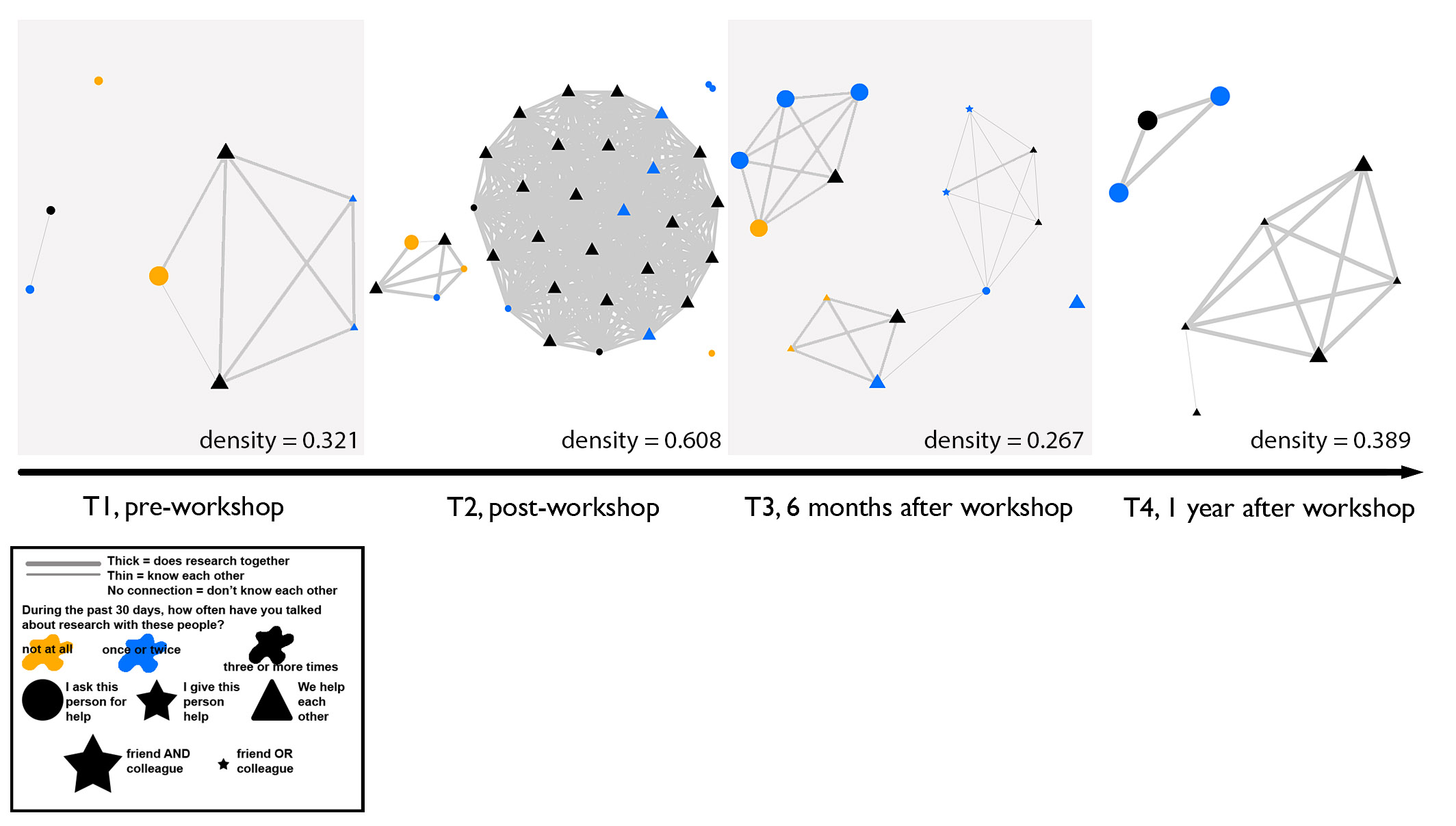
We used two ways to get at those perspectives. The first way was through a survey to all participants, 89 of whom responded. There were four big findings from the survey, all of which pointed to the design of the program having a positive influence on the trajectories of the participants: 1) the majority of the participants believed that the program helped them complete their IRDL project as well as conduct new research; 2) they reported that participating in the program helped them get tenure/promotions and salary increases, and/or new jobs; 3) they noted that their personal learning networks changed, as well as how they thought of themselves as a result of the program as a “librarian-researcher, and; 4) they reported boosted confidence in conducting research. That research was published (freely available to read) at https://journals.library.ualberta.ca/eblip/index.php/EBLIP/article/view/30094.

The second way we looked to understand the impacts of the program was through interviews and focus groups. Based on what we learned from the survey responses, we developed two sets of questions to dig deeper into some of the aspects of the program, to better understand what it’s like for the participants to incorporate research as part of their daily jobs and what kind of supportive measures and barriers for conducting research are in place in their workplaces. As a result of the prompts, most of the conversations were about research productivity, with the clear message that a supportive environment was important for them to conduct research, specifically identifying mentorship and becoming part of a research community. That research was published (also freely available to read) at https://journals.library.ualberta.ca/eblip/index.php/EBLIP/article/view/30461.

From a programmatic point of view, this reflective research has affirmed our decision to design IRDL around the concept of self-efficacy (mastery of the skill of conducting research, modeling of the research process, encouragement/support throughout the research process, and the feelings that come with conducting research {the positive and the negative!}) so that at the end of the year-long program, the participants know for themselves what they need in order to confidently conduct research and can seek it out.

I’m in debt to Frans Albarillo, the previous IRDL Scholar who took the lead on this research. We thought it was important that the “voice” of the research was from a participant themself and appreciate Frans stepping up to the plate to take on this multi-year project.

Albarillo, F., Kennedy, M., & Brancolini, K. (2022). Assessment of the Institute for Research Design in Librarianship (IRDL): Impact on the Research Productivity and Careers of Academic Librarians. Evidence Based Library and Information Practice17(4), 3–35. https://doi.org/10.18438/eblip30094

Albarillo, F., Kennedy, M., & Brancolini, K. (2024). Assessment of the Institute for Research Design in Librarianship, Phase 2: Impact on the Research Productivity and Careers of Academic Librarians. Evidence Based Library and Information Practice19(1), 4–34. https://doi.org/10.18438/eblip30461

Illustration. Chat box image, with IRDL entered into one of the boxes.

Posted in library | Comments Off on An assessment of the Institute for Research Design in Librarianship (IRDL)

Using our Journal Evaluation Tool to determine credibility of a journal

It’s been about seven years since we developed a tool (a downloadable rubric and explainer) to help our faculty determine the credibility of a journal. You can download the tool at https://digitalcommons.lmu.edu/librarian_pubs/40/ and read about the development of it at https://jlsc-pub.org/articles/abstract/10.7710/2162-3309.2250/. People have told us – often! – how they use the tool in their personal decision-making about where to publish, as well as sharing the tool in their classrooms and with friends. When we developed the tool, I hoped the set of decision criteria in it would be used to further the broader discussion about what is needed for an author to feel confident about submitting their work to a particular publisher.

I was delighted to see a recent article by Albro, et al., using ours as part of a critical evaluation of two tools like this, to determine the credibility of open access library science journals. Our tool was selected for the evaluation for two reasons: its alignment “with the current practice of using descriptive frameworks that empower authors to critically evaluate a journal’s quality and credibility, rather than provide a binary decision of good or bad,” and; its usability, in that it provides “guidance on application and a set list of criteria and measurements for determining quality or credibility” (p. 64).

The 6-person team of evaluators applied our rubric and the Open Access Journal Quality Indicators checklist (Beaubien & Eckerd, 2014) to a sample of 48 open access journals in the field of library science. The team noted that they preferred using our tool over the other one because of the “specific rules for distinguishing between Good, Fair, and Poor for each criterion” (p. 72) but noted that there was some ambiguity in using the rubric, especially as it relates to smaller publishers and hybrid journals. Also noted was that the inter-rater reliability was lower than that of the other tool (70.3%, compared to 81.7%).

The team identified some criteria and indicators that were similar across the tools (see their Table 5, on p. 73) as well as identified the top positive and negative attributes in library science journals, based on the two tools (Table 6, p. 76).

A thoughtful consideration by the authors is noted on p. 74, in which they ask, “Researchers should question … [if] the tools [are] asking the right questions and how should the goals of the tool change over time, especially as open access resources expand and transform?” The authors are aligned with my own thinking during the development of our tool, that “updates to existing tools are imperative, or new evaluation tools should be designed to account for the rapidly developing environment in which the research landscape now resides” (p. 75).

I am encouraged to see our field continue to engage in critical thinking about how an individual author may determine for themselves whether a particular journal is the appropriate outlet for their latest article, rather than relying on a prescribed list or tool that may miss some nuance or a key consideration that is important to that author. Thank you to the authors for engaging with our rubric. It means a lot to me personally that an idea I had has been able to be shaped into a useful tool that is still impacting the field, and I appreciate this critical eye on the work.

Albro, M., Serrao, J.L., Vidas, C.D., McElfresh, J.M., Sheffield, K.M., & Palmer, M. (2024). Applying Librarian-Created Evaluation Tools to Determine Quality and Credibility of Open Access Library Science Journals. portal: Libraries and the Academy 24(1), 59-81. https://doi.org/10.1353/pla.2024.a916990.

Beaubien, S. & Eckard, M. (2014). Addressing Faculty Publishing Concerns with Open Access Journal Quality Indicators”. Journal of Librarianship and Scholarly Communication 2(2), eP1133. https://doi.org/10.7710/2162-3309.1133

Blas, N., Rele, S., & Kennedy, M. R. (2019). The Development of the Journal Evaluation Tool to Evaluate the Credibility of Publication Venues. Journal of Librarianship and Scholarly Communication, 7(General Issue), eP2250. https://doi.org/10.7710/2162-3309.2250

Rele, S., Kennedy, M.R., & Blas, N. (2017). Journal Evaluation Tool. LMU Librarian Publications & Presentations 40. https://digitalcommons.lmu.edu/librarian_pubs/40

Ikon Uji Pemahaman (1) - Warna

Posted in library, OA, publishers, writing | Comments Off on Using our Journal Evaluation Tool to determine credibility of a journal

Drop some positivity in the next article you peer review

We recently received feedback on an article we submitted for publication, and I was delighted that the comments we received were all entirely positively toned and productive. The reviewer(s) brought up some issues that we could act on in the revision, and we were happy to make those changes. Overall, it was a good vibes review experience. Upon reflection, it was nice because of the attitude of the reviewer’s comments.

Over the years I’ve become accustomed to critical reviews that are couched in either neutral or negative language. That’s fine, I can take a critical review, and I know reviewers are likely just trying to get through the task, to move on to their next one. I tend not to take negative comments personally. The main thing I’m looking for are productive comments, actionable changes I can make to improve the manuscript.

With that as my focus, I had lost sight of how the tone of a reviewer comment can improve the whole experience. A note in the margins like this, then, caught my eye: “Excellent point and very important!” I could tell that the reviewer was engaged with the article, and interested in what we wrote. There were other notes like that sprinkled throughout the review, and it made all the difference to me.

If you’re the reviewer that commented on this latest article, thank you. You’ve inspired me to be proactive in putting forward this kindness in my future reviews.

Posted in writing | Comments Off on Drop some positivity in the next article you peer review

Mentoring Academic Librarians for Research Success

The major take-away from this book chapter is that the feedback about the IRDL Mentor Program (in place from 2016 to present day), from both mentors and Scholars, has been overwhelmingly positive. In the chapter we describe the process used by the program to recruit and select mentors, the pairing of mentors with their Scholars, and the general administration of the IRDL mentor program. We offer strategies for making the mentor-Scholar relationship work and tips for the design of a formal mentoring program.

A consistent refrain from both the mentors and the Scholars is that the experience, “is much better overall than other mentor/mentee experiences, especially in terms of the clear expectations and structure” (p. 250). In the chapter we aim to make the components of the program as transparent as possible, so that others may reproduce aspects of it in their own mentor programs. We provide some specific guidance for how to administer and maintain a year-long program in the two appendices, the IRDL Mentoring Program Contract and the monthly reflection prompts, designed to keep communication between the mentors and their Scholar consistent over the course of the program.

Read this chapter and get the Contract and monthly reflection prompts at no cost to you, at https://digitalcommons.lmu.edu/librarian_pubs/140/.

Jason, D.P., III, Kennedy, M.R., Brancolini, K.R. (2021). Mentoring Academic Librarians for Research Success. In L. J. Rod-Welch and B.E. Weeg (Ed.). Academic Library Mentoring: Fostering Growth and Renewal (pp. 241- 262). Chicago, Illinois: Association of College and Research Libraries.

Posted in IRDL, writing | Comments Off on Mentoring Academic Librarians for Research Success