Our Jonathan Gold tribute

Dave and I were sad to learn of the passing of Jonathan Gold, an icon in LA, known for his considerate, empathetic reviews of restaurants in the city. Inspired by his attempt to eat at every restaurant on the road he once lived on, Pico Blvd. (audio story at https://www.thisamericanlife.org/110/mapping/act-five), we decided to do something similar in our own neighborhood. Dave came up with this plan.

Instead of traveling down one road to eat we decided to use our house as a starting point and identified nine routes radiating out from there. Planning for thirty meals as our tribute time frame, we applied a random number generator to those nine routes. For each meal we would travel down the route that the number generator told us to follow. We also applied another random number generator for each meal, to tell us at which restaurant on that route we would eat.

From our house we would start driving, counting along the way. When we got to the restaurant that was the number given to us by the generator, that’s where we’d eat. Like Jonathan Gold on Pico Blvd., if we’d eaten there already, we’d go down one restaurant further. On Day 1, for example, the generator told us to take route 8, which is “from home, around the marina, down Pacific Ave.” The generator told us to go 23 restaurants away from our house, along that route, which was a place we’d driven by for 13 years and never gone to, the Canal Club.

Canal Club photo

This tribute experience has been a delight, taking us to places we’ve seen before and not gone into, places that are new, places we’ve never noticed. We’re at the half-way point of the tribute. Follow along on twitter at the hashtag #JGoldTribute, and take a look at where we’ve been at https://twitter.com/i/moments/1036678849541492736.

Posted in monkeys/bananas | Comments Off on Our Jonathan Gold tribute

Ugh, this codebook is a mess

Why do I leave codebook documentation until after the survey is launched? If I had created the codebook while I was still scripting the survey I would have noticed that I coded all the research support responses of “not offered” as 3s but I should have coded them as 0s. Now I’ll have to recode those responses before I start analysis so I don’t confuse myself when I’m interpreting the results. Sigh, such is the messy life of an academic.

screen shot of my messy codebook

Posted in organization tips, writing | Comments Off on Ugh, this codebook is a mess

Monkeys take baths to lower stress

Something this monkey has known for a while is that when she feels stressed out there is nothing like a hot bath for relief.

The National Geographic has published a brief summary of a research article about snow monkeys and the reason behind their dips in hot springs, at https://news.nationalgeographic.com/2018/04/japanese-snow-monkey-macaques-bath-stress-spd/.

monkey floating on a life preserver

Posted in monkeys/bananas | 1 Comment

Technical CATs

We have an initiative at the library to help our students spend less money on texts used in classes, called the Course Adopted Texts (CATs) E-Book Initiative. Our Librarian for Collection Development and Evaluation works with the campus bookstore to cross-reference course-adopted texts with e-books already purchased by the library. Where there is a match, she notifies faculty so they can direct students to the URL for the e-book.

When e-book licenses permit multiple simultaneous readers, those are perfect for use in a classroom setting, a GO. For subscribed content or licenses that permit just a few simultaneous readers, those may be sufficient for a small class or if it isn’t the main text for the class, a PAUSE. For licenses that permit only one reader at a time, those don’t work well in a class setting, when many people are usually trying to access the content at the same time, a NO.

We were trying to think of a visual way to convey GO, PAUSE, and NO to our users, along with text to explain whether or not an e-book was a good bet to be assigned for a course. I noodled around in our catalog and found that in Innovative Sierra an image can be coded (using HTML) to display to the public. My super awesome colleague, @CompareTheo designed three images to represent GO, PAUSE, and NO, as green, yellow, and red cats. He saved the images in our web space and then he added the HTML to the license records of our e-book collections. Here is an example of one of the cats in action:

Green cat example

This green cat image signifies the e-book is recommended for use in a multi-user setting, as a course-adopted text.

See what it looks like live, at http://linus.lmu.edu/record=b2403372~S2. All of the e-books that are linked to this license record will get the same text about Authorized Users, Concurrent Users, Course Adopted Text (CATS) Use, and Permitted Use.

Here’s the simple HTML string we inserted into the license record to make CATs happen: <img src=”URL_where_the_cats_picture_is_stored” height=”20″ width=”25″ style=”margin-top: 5px”><br> Recommended!

Posted in e-resource mgmt, license agreements, marketing | Comments Off on Technical CATs

Quality in qualitative research

Roller, Margaret R., and Paul J. Lavrakas. 2015. Applied Qualitative Research Design: A total quality framework approach. New York: Guilford Press.

If you’re interested in making sure that your qualitative research is trustworthy, and that your methods section doesn’t include statements like, “magic occurs here,” check this book out. The authors have developed a framework for designing qualitative research design to be credible, analyzable, transparent, and useful. They apply the framework to the usual qualitative methods (interview, observation, and more), prompting the reader to consider the four framework components throughout each method.

This is one of those books that as you read, you find yourself nodding along. If you’re designing an in-depth interview, for example, of course you know that you’ll want to make sure that the people you’re interviewing will be able to provide the data you need to answer your research question, and that those people are representative of a larger population. The book ties this intentionality of choosing the right people back to the framework component of credibility. *nod* In order for your research to be credible, you’ll want to select your interviewees carefully. Yes, you know this already, but unless something like this book is prompting you to make sure to do it right, well…we know how tired designing good research can make a person.

Give this book a read to affirm what you want out of your qualitative research, that it be considered rigorous and well designed.

BONUS: I learned about reflexive journaling from this book and am excited to give their journaling template (page 42) a try.

Book cover image

Posted in articles i'm reading | Comments Off on Quality in qualitative research

Interview with the authors — that’s me!

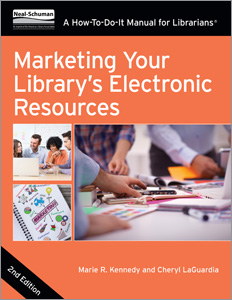
ALA Publishing has a real nice (and short) written interview up with me and Cheryl on their website, about our book Marketing Your Library’s Electronic Resources: A How-To-Do-It Manual for Librarians, at http://www.alaeditions.org/blog/297/interview-marie-r-kennedy-and-cheryl-laguardia-effectively-promoting-electronic-resources. Here’s a little snippet from the interview:

The first edition has been one of our bestsellers. Why did you write a second edition, and what are some of the most useful updates?

We learned so much from our readers about their experiences using the first edition that we wanted to incorporate all that feedback and share it widely. In the first edition our readers found the marketing plan reports we included very helpful – in this edition we’ve added some more. To help you get moving on your own marketing plans faster we’ve created a downloadable template. Grab it, use the prompts to consider the essential steps in a marketing plan, and get going!

Posted in book | Comments Off on Interview with the authors — that’s me!