oh man.
http://www.monkeybusiness.co.il/product.cfm?MB_cId=16&MB_pId=180&nosub=1
The cycle of mounting and executing and moving on to the next project has skidded to a halt, and he cannot say why. It does not make sense to him. Not this night or any other, not at any level of the brandy bottle. This is not how it is supposed to work. A project is started, it is developed and mounted and sent out into the world, and more often than not it becomes self-sufficient. And then he is no longer needed. It is not always a pleasant position to be in, but it is the way of such things, and Chandresh knows this process well. One is proud, one collects one’s receipts, and even if one is a bit melancholy, one moves on. — p. 243 The Night Circus, Erin Morgenstern
I’m in the process of completing our book, doing final changes at the editor’s request. It occurs to me that the book will soon exist on its own, without my further development of it or interaction with it, soon to be “sent out into the world.” Melancholy, indeed.
We’re in Week 13 of 16 of the Collaborative Marketing for Electronic Resources project, nearing the finish. This has been such a satisfying project on a personal level, training around 100 librarians in how to construct a marketing plan for their libraries’ electronic resources. I’m really looking forward to sifting all the data that results from the project. I’ll be reporting on the project – the impetus, the planning, the execution and results of the effort – at the upcoming annual conference, Electronic Resources & Libraries. Here’s a link to the brief abstract for the presentation: http://www.electroniclibrarian.com/conference-info/erl-2012-sessions.

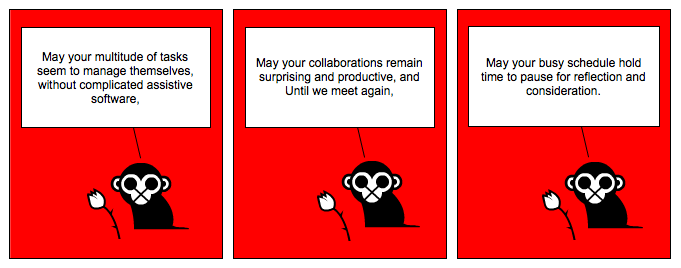
need more monkey comics? head on over to stripgenerator: http://orgmonkey.stripgenerator.com/
If you’re an academic e-resources librarian you know that during the school year you are in a holding pattern, continually looping to the right, with fingers crossed that e-resource platforms and interfaces remain stable and accessible. The goal of the academic e-resource librarian during the school year is “no change.” We want our patrons to have seamless access in exactly the same way, all semester long. This maximizes their productivity because they know what to expect when they go to a vendor platform; changes mid-semester are awful for researchers because they have to stop their research to learn how to use a new platform.
The minute the semester ends and grades are in we give ourselves the okay to land the plane. The ends of semesters are our busy times, when we migrate to new platforms, make upgrades to interfaces, alter URLs, and update security certificates. That means that right before the winter holiday I am a crazy pilot, chugging coffee on 8-hour shifts. During this break in the academic calendar, for example, I have plans to migrate to the new GVRL interface, remove old URLs from our proxy server, remove a bunch of titles from our Research Databases page that we have deemed “not databases,” set up Scholarly Stats, and pull reports of WebFeat search entries.
To manage the changes I keep a running list in a text file during the academic semester of alterations that need to be made. About a month away from the end of the semester I schedule time to make the changes in my calendar, working backward with extra appointments for myself if I need to gather information or collaborate with others to complete the process. It makes for a busy but organized holiday season. HO HO HO!
I started reading this article for the usability testing content but ended up loving it because of this little marketing nugget of information.
BGSU students were most successful navigating the library’s database web pages when they were looking for the names of specific resources, not when they were browsing by subject. Therefore, if we want students to use a wider range of our resources, it is crucial that we teach them to recognize the resources that will be useful for them. … One way to do this might be to connect lesser-known databases to the most popular ones (for example, Project MUSE and JSTOR, Factiva and LexisNexis, or the ISI Web of Science and EBSCO) in instruction sessions, campus communications, and web guides. Ideally, students familiar with one resource would be able to link the two databases in their minds and remember or recognize both at their point of need.
Fry, Amy, and Linda Rich. 2011. Usability testing for e-resource discovery: How students find and choose e-resources using library websites. The Journal of Academic Librarianship 37, no.5: 386-401.